By Olayinka Owolabi
the Anambra State Government has responded to claims by former Governor Peter Obi concerning the state’s public debt profile under his administration, accusing the former governor of leaving behind outstanding external loans, salary and pension arrears as well as other liabilities.
The state government, in a press statement signed by the Commissioner for Information, Law Mefor, on Wednesday, said the response was necessary following what it described as a viral post by Obi titled “Debunking the Phantom Debts and Ecological Loan Fallacy.”
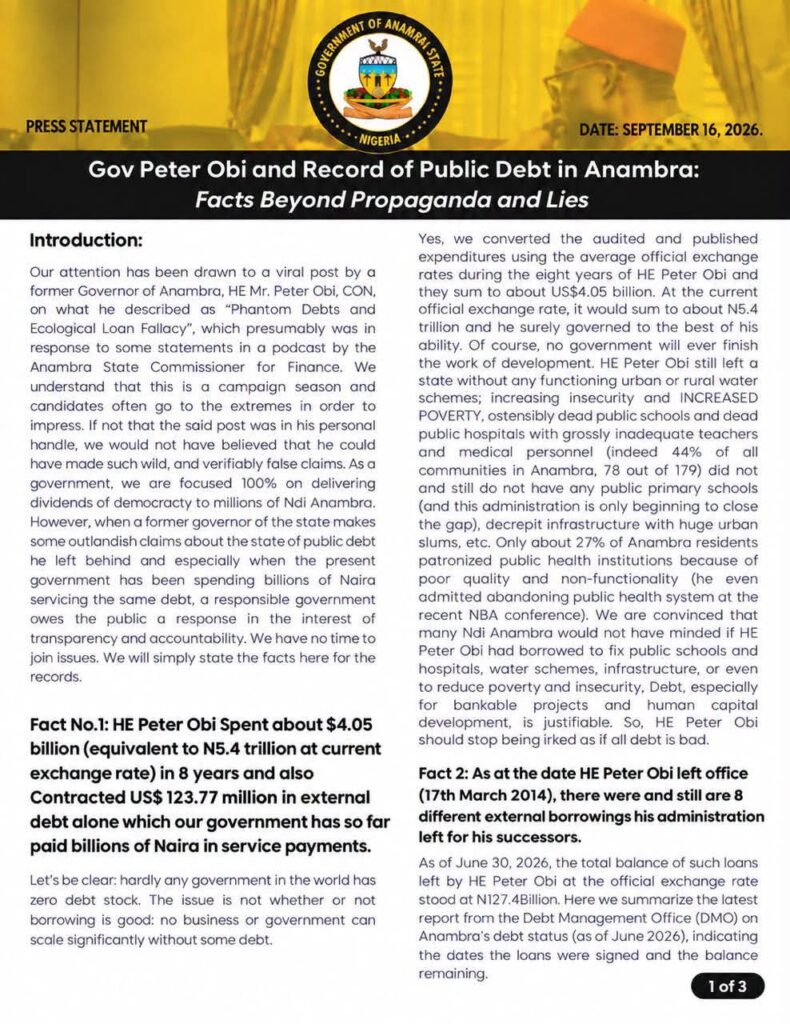
The statement, titled “Gov Peter Obi and Record of Public Debt in Anambra: Facts Beyond Propaganda and Lies,” said the government was responding in the interest of transparency and accountability, particularly because the current administration had continued to service some of the debts allegedly incurred during Obi’s tenure.
The government said, contrary to Obi’s position, its records showed that his administration spent about $4.05 billion during his eight years in office when audited and published expenditures were converted using average official exchange rates applicable during the period.
While Obi has disputed claims that his administration left behind the debts and liabilities being attributed to it, the state government said its figures were based on official debt records and documented liabilities.
It, however, clarified that the figure represented expenditure over the eight-year period and not necessarily borrowing.
According to the statement, “we converted the audited and published expenditures using the average official exchange rates during the eight years of HE Peter Obi and they sum to about US$4.05 billion.”
The government said the amount would be equivalent to approximately N5.4 trillion using the current official exchange rate, while acknowledging that Obi governed the state to the best of his ability.
It also argued that borrowing by governments was not inherently wrong, provided such funds were used for productive and bankable projects capable of generating development and improving human capital.
The statement said the issue was therefore not whether a government should have debt, but the purpose for which the funds were borrowed and the obligations left for succeeding administrations.
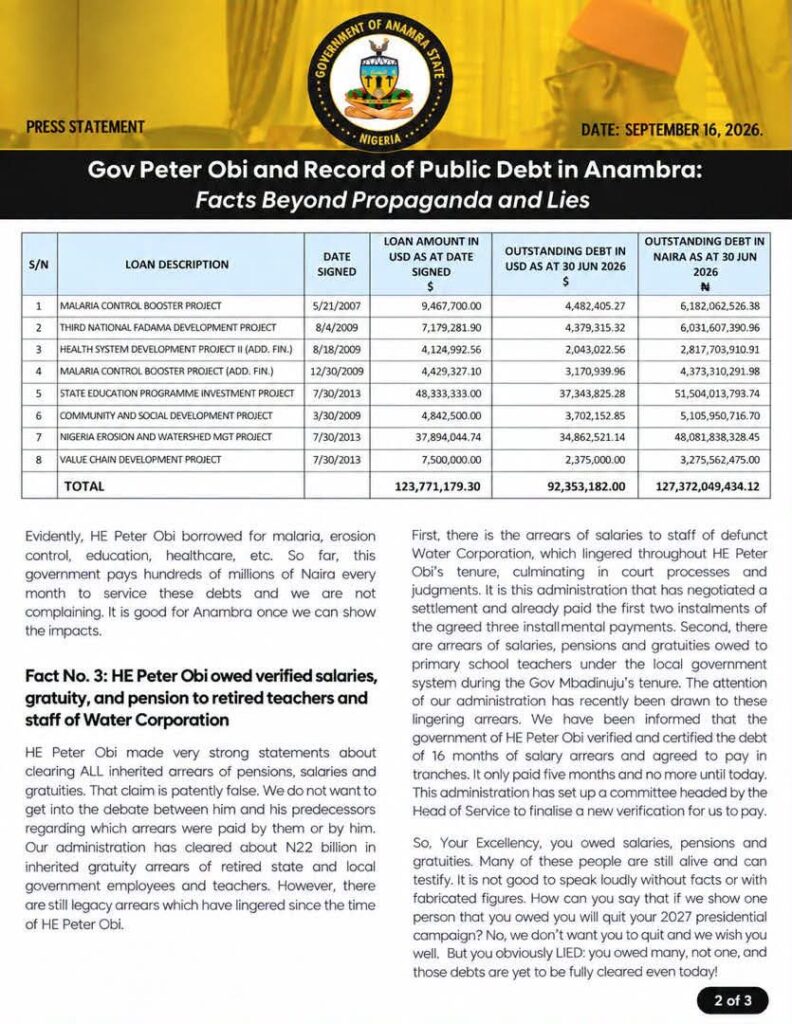
The Anambra Government specifically alleged that Obi’s administration contracted US$123.771 million in external debt, adding that eight separate external borrowing arrangements remained outstanding when he left office on March 17, 2014.
The government said the loans were obtained for projects covering areas including malaria control, health system development, education, erosion and watershed management, community and social development, and value-chain development.
It said the current administration had continued to make debt-service payments on the loans, describing the projects for which the funds were borrowed as legitimate development needs.
“Evidently, HE Peter Obi borrowed for malaria, erosion control, education, healthcare, etc. So far, this government pays hundreds of millions of Naira every month to service these debts and we are not complaining. It is good for Anambra once we can show the impacts,” the statement said.
The state government also challenged Obi’s claim that his administration cleared all inherited arrears relating to salaries, pensions and gratuities.
According to Mefor, the current administration had cleared about N22 billion in inherited gratuity arrears owed to retired state and local government employees and teachers.
It specifically cited arrears involving staff of the defunct Anambra State Water Corporation, alleging that salary arrears had lingered throughout Obi’s tenure and subsequently resulted in court processes and judgments.
The statement said the Soludo administration had negotiated a settlement with the affected workers and had already paid the first two instalments under an agreement involving three instalmental payments.
The government said “it had been informed that the Obi administration had verified and certified 16 months of salary arrears owed to the affected workers and agreed to pay them in tranches, but had paid only five months.”
The present administration, it added, had constituted a committee headed by the Head of Service to finalise verification of the outstanding obligations.
The government also questioned the criticism of debt itself, arguing that borrowing could be justified where it was used to finance critical infrastructure, public services and human-capital development.
The statement claimed that 44 per cent of Anambra communities—78 out of 179—did not have public primary schools at the time and that only about 27 per cent of residents patronised public health institutions, which it attributed to poor quality and non-functionality.
The government further said Obi left the state with infrastructure challenges and urban slums, while arguing that borrowing for projects capable of addressing such challenges could be considered legitimate.
“We are convinced that many Ndi Anambra would not have minded if HE Peter Obi had borrowed to fix public schools and hospitals, water schemes, infrastructure, or even to reduce poverty and insecurity,” the statement said.
“Debt, especially for bankable projects and human capital development, is justifiable. So, HE Peter Obi should stop being irked as if all debt is bad.”
The government said it was not seeking to engage in a political argument but wanted the public to have access to what it described as the facts surrounding the state’s debt profile.
It maintained that the issue should be viewed within the context of the projects financed by the loans, the repayment obligations inherited by successive administrations and other outstanding liabilities.